BATJ 2026 Poster Presentation|第28回英国日本語教育学会年次大会ポスター発表
From Reel to Reading:
Connecting Short-Form Japanese Story Videos and Japanese Extensive Reading to Support Autonomous Out-of-Class Reading
リールから読みへ:
短尺SNS動画と日本語多読の接続による自律的教室外多読の支援
This mixed-methods learner survey explored how short-form Japanese story videos might offer an approachable entry point to reading, and what support might help learners move from a story encountered in a Reel to rereading it in a worksheet and, potentially, to further extensive reading.
短尺日本語ストーリー動画が日本語読書に気軽に触れるきっかけとなり得るか、また、動画で触れたストーリーをワークシートで読み直すことや、その先の多読へ進むことに、どのような支援が役立ち得るかを探った、混合研究法による学習者調査です。
Study at a glance|調査概要
51 adult learners · 33 Likert items + 3 open-text questions · 6 follow-up interviews
18歳以上の日本語学習者51名 ・ 5件法33項目 + 自由記述3問 ・ 6名へのフォローアップ・インタビュー
What did the study find?|本調査でわかったこと
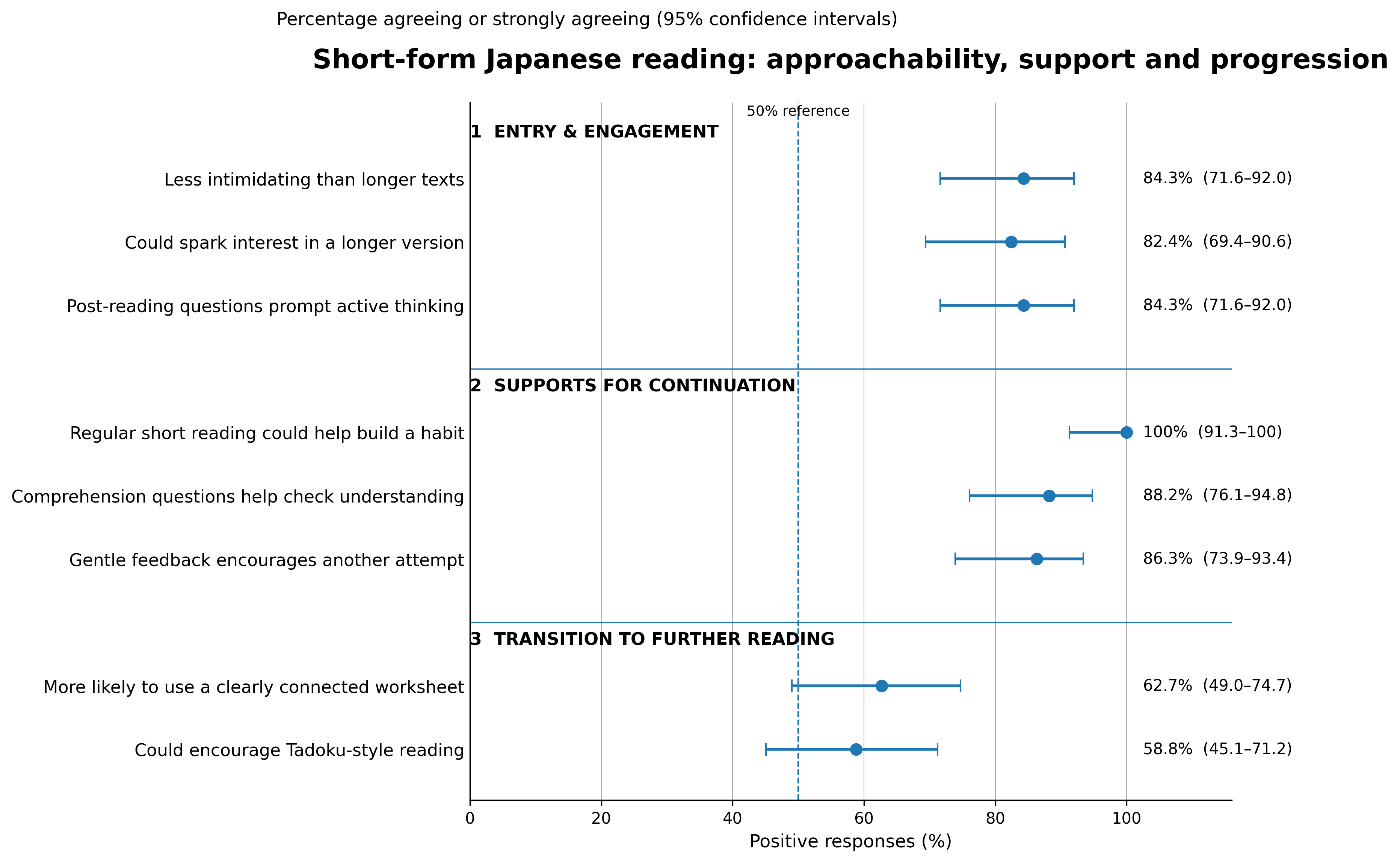
Items describing short-form Japanese story videos as an approachable entry point to reading, and selected supports for continuing to read, received high levels of agreement. Agreement was comparatively lower for items concerning movement from a Reel to a same-story worksheet or onward to Tadoku-style reading.
短尺日本語ストーリー動画を読みへの取り組みやすい入り口として捉える項目と、読みの継続を支える項目では、肯定回答の割合が高い結果となりました。一方、リールから同じストーリーのワークシートや、その先の多読へ進むことに関する項目では、肯定回答の割合が相対的に低い結果となりました。
1. Reels as an entry to reading|読みの入り口としてのリール
Positive responses: 82.4–84.3%|肯定回答割合:82.4~84.3%
Learners responded positively to three ideas: short story videos may feel less intimidating than longer texts; they may spark interest in longer reading; and answering post-reading questions may prompt more active thinking about the story.
「長い文章より取り組みやすい」「より長い読み物への関心につながり得る」「読後の質問に答えることで、内容をより能動的に考えられる」の3項目で、肯定回答の割合が高い結果となりました。
2. Support for continuing to read|読みの継続を支える要素
Positive responses: 86.3–100%|肯定回答割合:86.3~100%
Learners responded positively to regular short reading as a way to build a habit, comprehension questions as a way to check understanding, and gentle correction or feedback on short answers as encouragement to try again.
「定期的な短い読書が読書習慣の形成に役立つ」「理解確認の質問で内容理解を確かめられる」「短い回答・例文への穏やかな訂正やフィードバックが、もう一度書いてみようという意欲につながる」の3項目で、肯定回答の割合が高い結果となりました。
3. From Reel to worksheet and Tadoku|リールからワークシート・多読への接続
Positive responses: 58.8–62.7%|肯定回答割合:58.8~62.7%
Agreement was comparatively lower for two ideas: learners would be more likely to use a worksheet clearly linked to a Reel they had already watched, and short story videos could encourage Tadoku-style reading.
「リールとのつながりが明確なら、ワークシートを利用する可能性が高まる」「短尺動画が多読形式の読書を試すきっかけになり得る」の2項目では、肯定回答割合が相対的に低い結果となりました。
Positive responses combine “Agree” and “Strongly agree”. Valid responses were n = 50–51 per item; 95% confidence intervals are shown in the chart.
※肯定回答は「そう思う」「とてもそう思う」の合計です。各項目の有効回答数はn=50~51で、グラフには95%信頼区間を示しています。
See the content shown in the study
研究で提示したコンテンツを見る
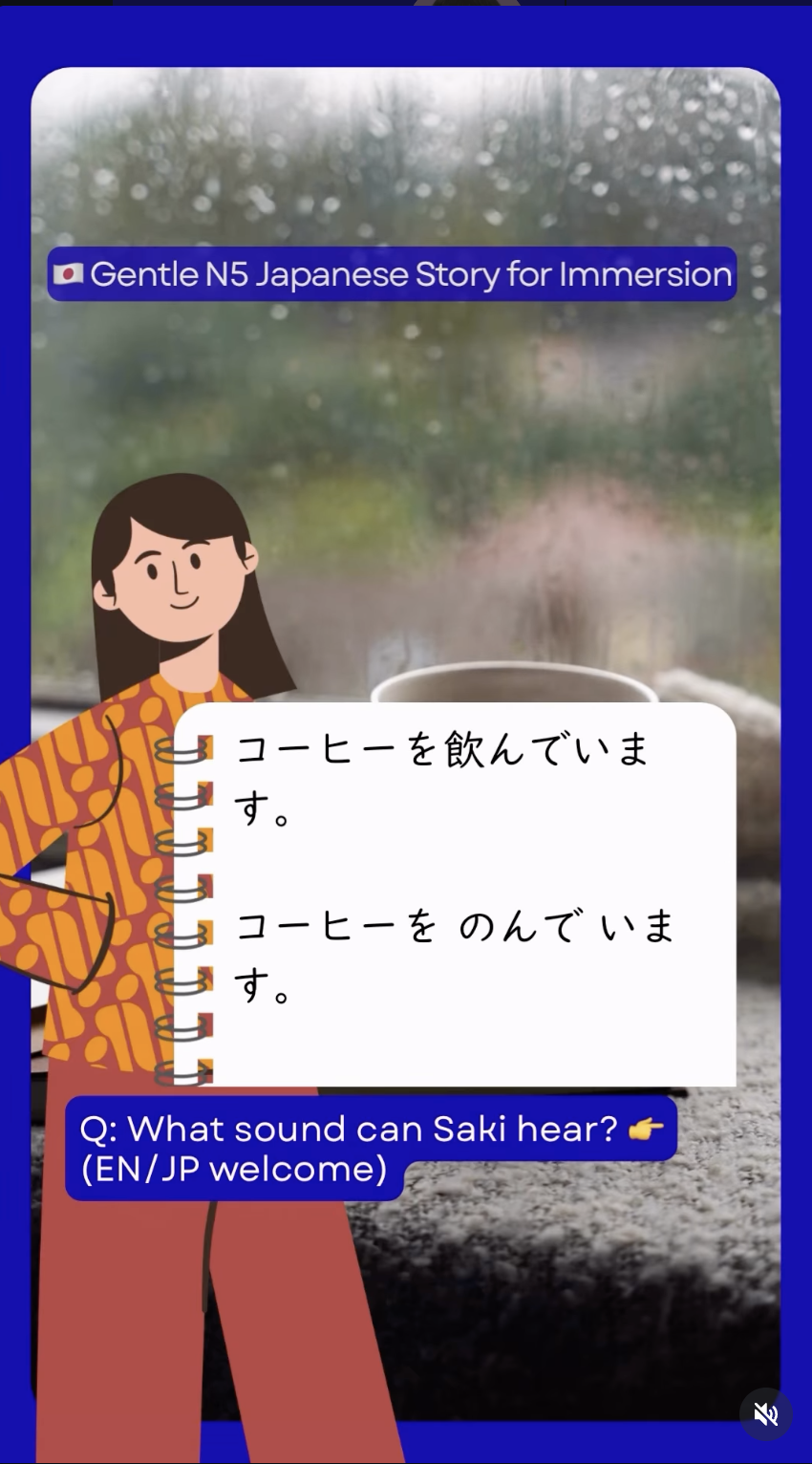
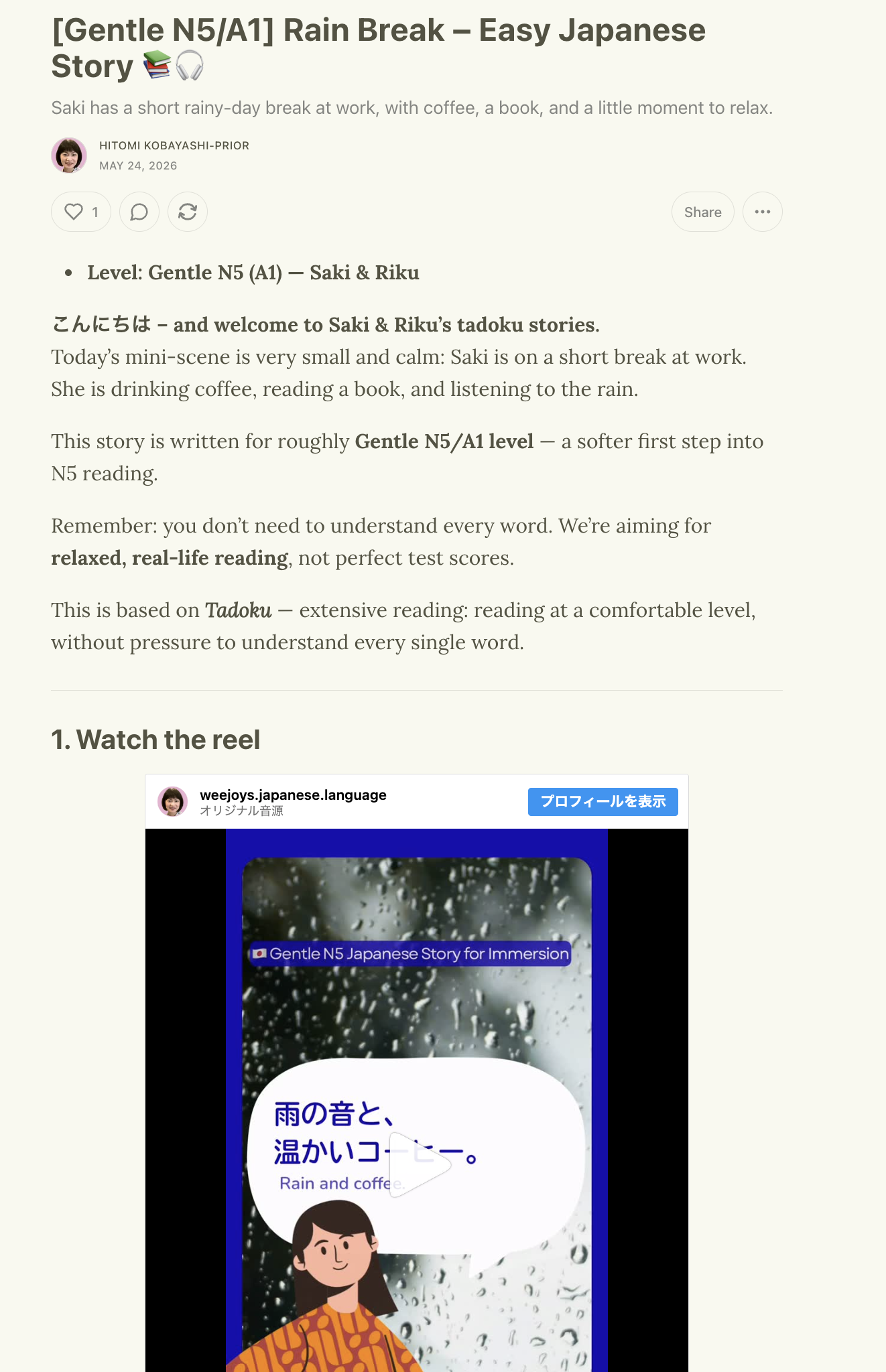
The survey included thumbnails of the Reel and worksheet shown below. In the follow-up interviews, participants viewed the full Reel and corresponding worksheet as shared prompts for discussion.
質問紙では、以下のリールとワークシートのサムネイルを提示しました。フォローアップ・インタビューでは、実際のリールと対応するワークシートを全員に提示し、それらを見た上で感じたことや考えたことを話してもらいました。
Short-form story Reel|短尺日本語ストーリー・リール
A short Japanese story Reel with a level label, sentence-by-sentence visual support, repetition and an on-screen comprehension question. The caption provides a hint and a link to the same-story worksheet; posts also invite viewer responses in the comments.
レベル表示、文の内容に合わせた視覚的補助、ストーリーの反復、画面上の内容理解の質問を組み込んだ短尺日本語ストーリー・リール。キャプションには質問のヒントと、同じストーリーを使ったワークシートへの導線があり、コメント欄で視聴者の回答も募ります。
How it works|構成と流れ
Check the level|レベルを確認する
The Reel displays its approximate Japanese level.
リールには、おおよその日本語レベルを表示しています。Follow the story with visual support|視覚的な手がかりとともにストーリーを視聴する
The screen changes roughly sentence by sentence, with background video selected to support the meaning of each part of the story.
おおよそ一文ごとに画面が切り替わり、各文の内容に合った背景動画が、意味を捉えるための視覚的な手がかりになります。Watch and listen to the story twice|同じストーリーを2回視聴する
The full story is presented twice, giving viewers another opportunity to follow the language and meaning.
ストーリー全体を2回提示し、同じ日本語と内容にもう一度触れられるようにしています。Answer a comprehension question|内容理解の質問に答える
A comprehension question appears on screen, prompting viewers to check what they understood from the story.
画面上に内容理解の質問を提示し、ストーリーから理解したことを確認できるようにしています。Continue through the caption and comments|キャプションやコメントから次につなげる
The caption gives a hint for the question and directs viewers to the same-story worksheet. In some posts, viewers can also leave their answers in the comments, where the creator may respond and provide an example answer.
キャプションには質問のヒントと、同じストーリーを使ったワークシートへの導線があります。投稿によっては、視聴者がコメント欄に回答を書き込み、それに対して投稿者から返信や解答例が示されることもあります。
Follow-on worksheet|リールと同じストーリーを使ったワークシート
A follow-on worksheet using the same Japanese story as the Reel. Learners can reread the story in a kana-only, romaji-supported or kanji-and-kana version, check their comprehension, review a key language pattern, and try a short optional output task.
リールと同じ日本語ストーリーを使ったワークシート。かなのみ・ローマ字サポート・漢字かな交じりから読みやすい表記を選んでストーリーを読み直し、内容理解やポイントとなる表現を確認したうえで、短いアウトプットにも取り組めます。
How it works|取り組みの流れ
Watch the embedded Reel|ワークシートに埋め込まれたリールを視聴する
The Reel can be watched again before moving into the reading activity.
読書活動に進む前に、同じリールをもう一度視聴することができます。Choose a text version and reread|読みやすい表記の本文を選んで読み直す
Learners choose a kana-only, romaji-supported or kanji-and-kana version and reread the same story shown in the Reel.
かなのみ・ローマ字サポート・漢字かな交じりから読みやすい表記を選び、リールで見たのと同じストーリーを読み直します。Check understanding|内容理解を確認する
Short questions help learners check key details from the story without turning the activity into a test.
短い質問を使って、テストのような負担を増やさずにストーリーの主な内容を確認します。Notice a key language pattern|ポイントとなる表現・文型に注目する
One useful expression or language pattern from the story is highlighted for brief noticing and review.
ストーリーに出てきた表現・文型の中から一つを取り上げ、無理のない範囲で気づきと確認につなげます。Try a short optional output|任意で短いアウトプットに取り組む
Learners can use the featured pattern in one short sentence of their own, with models and prompts provided.
例やヒントを参考に、取り上げた表現・文型を使って自分の短い一文を作ることができます。
METHODS|研究方法
Participants & Methods
研究参加者と方法
The study combined quantitative survey data with open-ended questionnaire responses to explore how learners perceive short-form Japanese story videos, reading support through worksheets using the same story as the Reel, and out-of-class extensive reading.
本研究では、短尺日本語ストーリー動画、動画で提示した同じストーリーを使ったワークシートによる読書支援、教室外多読に対する学習者の捉え方を検討するため、質問紙の量的回答データと自由記述回答データを組み合わせて分析しました。
1. Participants|研究参加者
51 adult learners of Japanese
All participants were aged 18 or over and provided informed consent.
Levels ranged from beginner to advanced.
After completing the survey, participants could choose to enter a prize draw.
18歳以上の日本語学習者51名
全参加者から研究参加への同意を得ました。
初級から上級までを含みます。
希望者は、回答後に謝礼の抽選に応募できました。
2. Questionnaire|質問紙
33 Likert items + 3 open-text questions
Five-point Likert items explored five areas:
an approachable entry point to reading
structure that supports learner autonomy
thinking about what was read and deepening understanding
visibility of progress and feedback
content trustworthiness and organisation, and challenges in use
5件法33項目+自由記述3問
5件法の質問項目では、以下の5つの領域を扱いました。
読書に気軽に触れるきっかけ
自律性を支える構造
読んだ内容について考え、理解を深めること
進捗の可視化・フィードバック
コンテンツの信頼性・整理と利用上の課題
3. Quantitative analysis|量的分析
Descriptive and exploratory analysis*
Descriptive statistics and positive-response proportions with 95% confidence intervals were calculated. We used non-parametric tests for preselected exploratory group comparisons, with Holm adjustment where applicable. We conducted statistical analyses using jamovi (Version 2.7.38.0).
記述的・探索的分析
記述統計を算出し、あわせて肯定回答割合と95%信頼区間を求めました。探索的な群間比較の対象は、群ごとの結果を確認する前に選定しました。比較にはノンパラメトリック検定を用い、必要に応じてHolm補正を行いました。統計処理にはjamovi (Version 2.7.38.0)を使用しました。
*See the plain-language explanation below: “What did we do with the survey data?”
平易な説明は、下の「質問紙データをどのように分析した?」をご覧ください。
4. Qualitative analysis|質的分析
Open-text analysis
We analysed open-ended responses using qualitative content analysis. The five survey areas were used as a deductive reference, while codes and categories were developed and refined inductively from the data.
自由記述回答の分析
自由記述回答には質的内容分析を用いました。質問紙で設定した5領域を参照しつつ、データに基づいてコードやカテゴリーを形成・修正しました。
What did we do with the survey data?|質問紙データをどのように分析した?
A plain-language explanation of the statistical analysis
統計分析を専門用語をできるだけ使わずに説明します
First, we summarised how participants responded to each survey item and calculated the percentage who selected “Agree” or “Strongly agree”. Also, because response percentages can vary to some extent, we showed a range indicating how wide the estimate might reasonably be (95% confidence interval).
各質問への回答をまとめ、「そう思う」「とてもそう思う」と答えた人の割合を算出しました。また、回答の割合にはある程度のばらつきがあり得るため、その推定にどの程度の幅があるかを示す範囲(95%信頼区間)も示しました。
We examined whether response patterns might vary with social media viewing frequency, Japanese reading frequency, prior exposure to Japanese-learning Reels or worksheets created by the researcher, previous Tadoku experience, and Japanese proficiency. These exploratory comparisons were intended to identify patterns that might be worth investigating further, not to confirm that particular groups necessarily differed.
For the primary group comparisons, the survey items were selected in advance, based on the research questions and before the group results were examined.
短尺SNS動画の視聴頻度、日本語の読書頻度、研究者が制作した日本語学習用のリールやワークシートに接した経験、多読経験、日本語の熟達度などによって、回答傾向が異なる可能性があるかを調べました。これらの探索的比較は、特定のグループ間に必ず違いがあると確認するためではなく、今後さらに調べる価値のある傾向を見いだすために行いました。
主な群間比較で扱う質問項目は、研究課題に基づき、群ごとの結果を確認する前に選定しました。
Because the response data came from a five-point scale and some comparison groups were relatively small, we used statistical methods that do not assume a normal distribution (non-parametric tests).
Where several related comparisons were made, we applied a Holm adjustment to reduce the chance of finding an apparent difference simply because multiple comparisons had been carried out.
回答データは5段階尺度によるもので、一部の比較群の人数も比較的少なかったため、データが正規分布に従うことを前提としない統計的方法(ノンパラメトリック検定)で比較しました。
関連する比較を複数行った場合には、比較の回数が増えることで偶然「違いがある」ように見える可能性を抑えるため、Holm補正を行いました。
For the proficiency analysis, we also carried out some additional comparisons after reviewing the initial results. These analyses are clearly distinguished from the comparisons selected in advance and identified as post hoc exploratory analyses. They are treated as tentative patterns for further investigation, rather than as firm conclusions.
熟達度別分析では、当初の結果を確認した後に行った追加比較もあります。これらは、事前に選定した比較と明確に区別し、事後的な探索的分析として示しています。確定的な結論ではなく、今後さらに検討すべき暫定的な傾向として扱っています。
Follow-up interviews|フォローアップ・インタビュー
Six semi-structured follow-up interviews were completed.
We selected six participants from survey respondents who expressed interest in a follow-up interview. No incentive was offered for interview participation.
For this poster, we include interview data only as preliminary observations from transcript familiarisation.
質問紙回答時にフォローアップ・インタビューへの参加を希望した回答者の中から6名を選定し、半構造化フォローアップ・インタビューを実施しました。インタビュー参加に対する謝礼はありませんでした。
本ポスターでは、書き起こしデータへの精通段階で得られた予備的な観察のみを扱います。
What the open-text responses added
自由記述回答から
みえたこと
Fit matters
Learners mentioned level-appropriate challenge, vocabulary and grammar support, and guidance in choosing suitable materials.
学習者のレベルに合った読み物、語彙・文法の支援、適切な教材を選ぶための案内への言及がみられました。
Continuity matters
Responses referred to gradual progression, connected series and clear guidance on what to read next.
段階的に難易度が上がる構成、内容につながりのあるシリーズ、次に何を読めばよいかが分かる案内への言及がみられました。
Opportunity is situational
Responses referred to time, motivation, attention and concentration, and the characteristics of social media as factors affecting whether learners could engage with reading.
読書に取り組めるかどうかに関わる要因として、時間、意欲、注意・集中、SNSという媒体の特性への言及がみられました。
Open-ended questionnaire responses; qualitative content analysis using the survey framework as a deductive reference, while developing and refining codes and categories inductively from the data.
質問紙の自由記述回答を、質問紙の5領域を演繹的な参照枠とし、コード・カテゴリーをデータから帰納的に形成・修正する質的内容分析によって検討しました。
EXPLORATORY ANALYSIS|探索的分析
Does proficiency matter?
熟達度による違いはあるか
Exploratory analyses suggested that the types of support learners valued might differ by proficiency.
Of the seven items selected before examining the group results, the Higher group gave lower ratings than the Lower (beginner–N4) and/or Intermediate groups on two items: the likelihood of using a worksheet clearly linked to a Reel, and level labels that help learners choose suitable reading materials.
Open-text responses showed a similar broad pattern. Lower (beginner–N4) and Intermediate learners referred more often to explicit language support, such as vocabulary and grammar support. Higher-proficiency learners, meanwhile, requested more challenging materials, natural expressions, and content about present-day Japanese society and current affairs.
探索的分析では、学習者が重視する支援の種類が、熟達度によって異なる可能性がうかがわれました。
群ごとの結果を確認する前に選定した7項目のうち、「リールと明確につながるワークシートの利用意向」と「読み物選択を助けるレベル表示」の2項目では、上級群の評価が初級~N4群または中級群より低くなりました。
自由記述でも、初級~N4群と中級群では、語彙・文法などの明示的な言語支援への言及が比較的多くみられました。一方、上級学習者からは、より難度の高い教材や自然な表現、現在の日本社会や時事的な話題を扱う内容への要望がみられました。
Support may still matter at higher levels, but the types of support learners value may differ by proficiency.
熟達度の高い学習者にも支援が不要とは限らず、価値を感じる支援の種類は熟達度によって異なる可能性があります。
FOLLOW-UP INTERVIEWS|フォローアップ・インタビュー
Preliminary observations from interview familiarisation
インタビュー書き起こしの精通段階で得られた予備的観察
Six semi-structured follow-up interviews were completed. Formal Framework Method analysis is planned as a subsequent stage of the research project.
半構造化フォローアップ・インタビューを6名に実施しました。Framework Method(フレームワーク法)による分析は、本研究プロジェクトの次の段階で行う予定です。
Different modes of engagement
Even within the same sequence — watching a Reel and then rereading the same story in a worksheet — some participants experienced it as light practice, while others regarded it as deliberate study. Short-form content was not necessarily a low-effort activity for every learner.
Moving from the Reel to the same-story worksheet is not automatic
Watching a Reel did not automatically lead to rereading the same story in the worksheet. Whether participants moved on appeared to depend on available time, readiness or motivation to study, level fit and whether the next step was clear.
Appropriate support may help autonomous choice
Level information, a clear link to the same-story worksheet and visibility of the learning sequence could make it easier for learners to decide what to work on, when to do it and how far to continue.
学習としての受け止め方は人によって異なる
同じ「リールでストーリーを見る→同じストーリーを使ったワークシートで読み直す」という流れでも、気軽な練習として受け止める人もいれば、意識的な学習活動として捉える人もいました。短尺動画コンテンツが、すべての学習者にとって一様に負担の少ない活動になるわけではないことがうかがわれました。
リールから同じストーリーのワークシートでの読み直しへ、自動的に進むわけではない
リールを見たことが、そのまま同じストーリーをワークシートで読み直すことにつながるわけではありません。ワークシートに取り組める時間があるか、そのとき学習に向かう気持ちの余裕や意欲があるか、リールやワークシートの日本語レベルが自分に合っているか、次に何をすればよいかが分かるか、といった条件が、短尺動画を見た後に、同じストーリーをワークシートで読み直すかどうかに関わる可能性がうかがわれました。
適切な支援は、自律的な選択を助ける可能性がある
短尺動画に、自分に合ったレベルを選ぶための情報や、同じストーリーを使ったワークシートへの案内、動画とワークシートによる学習の設計が見通せる仕組みがあることで、学習者が自分で「何に取り組むか」「いつ取り組むか」「どこまで進めるか」を選びやすくなる可能性がうかがわれました。
These observations are based on transcript familiarisation only and are not themes or findings derived from Framework Method analysis.
ここで示した内容は、インタビュー書き起こしを精読する段階で得られた予備的観察であり、フレームワーク法による分析から得られたテーマや研究結果ではありません。
IMPLICATIONS|教育的示唆
What might this mean for learning design?
学習設計に活かせること
Use short-form video as an entry point to reading
Short-form content may work best as an approachable entry point to reading rather than as a complete reading experience.
Offer clear choices for moving to a worksheet or Tadoku
A worksheet using the same story as the Reel should be easy to find, clearly linked and possible to return to later. Further extensive reading can then be offered as an optional next step.
Support continued reading without overload
Comprehension checks, regular short reading, progress visibility and gentle feedback may help learners continue.
Adapt support to proficiency
More proficient learners may need greater challenge and authenticity, not simply less support.
短尺日本語ストーリー動画を読書への入り口として活かす
短尺日本語ストーリー動画は、それだけで完結する読書経験としてではなく、気軽に読書に触れる入り口として活かせます。
ワークシート・多読への明確な選択肢を示す
リールと同じストーリーを使ったワークシートを見つけやすくし、リールとのつながりを明確にして、後からでも取り組めるようにします。その先の多読は、さらに進みたい学習者が選べる次のステップとして提示します。
無理なく読み続けられるよう支援する
理解確認、短い文章を定期的に読むこと、進捗が見えること、負担の少ないフィードバックは、継続を支える可能性があります。
熟達度に合わせて支援内容を変える
熟達度の高い学習者には、単に支援を減らすのではなく、より難度が高く、自然な表現を含む読み物や、現在の日本社会・時事的な話題を扱う内容が求められる可能性があります。
LIMITATIONS|研究の限界
What this study cannot yet tell us
この研究から、まだ明らかにできないこと
The survey measured learners’ reported attitudes and intentions, not observed changes in reading behaviour. Participants were not randomly selected but chose to take part in the survey. In addition, the exploratory subgroup analyses were based on relatively small, unequal-sized groups.
The six follow-up interviews provide rich additional data, but they have not yet undergone formal Framework Method analysis.
本調査で測定したのは、実際の読書行動の変化ではなく、学習者が自己報告した態度と意向です。また、調査参加者は無作為に選ばれたのではなく、調査への参加を希望した人たちです。探索的な群別分析も、比較的人数が少なく、各群の人数が均等ではありません。
6名のフォローアップ・インタビューからは豊富な追加データが得られていますが、フレームワーク法による分析はまだ行っていません。
Next step
The next stage of the project will analyse the interview data in depth and integrate the survey and interview findings to examine under what conditions, and for whom, short-form Japanese social media content may serve as a bridge to sustained out-of-class extensive reading.
次のステップ
本研究プロジェクトの次の段階では、インタビューデータを詳細に分析し、質問紙とインタビューの結果を統合することで、どのような条件で、どのような学習者にとって、短尺日本語ストーリー動画が継続的な教室外多読への橋渡しとして機能し得るのかを検討します。
RESOURCES|資料
Explore the full results
全結果・ポスター
The poster highlights selected findings. Full survey results, proficiency analyses and the poster PDF are available below.
ポスターでは、調査結果の一部を抜粋して紹介しています。質問紙の全結果、熟達度別分析、ポスターPDFは以下からご覧いただけます。
References|参考文献
Yeh, E., & Mitric, S. (2020). Bridging activities: Social media for connecting language learners’ in-school and out-of-school literacy practices. International Journal of Computer-Assisted Language Learning and Teaching, 10(3), 48–66. https://doi.org/10.4018/IJCALLT.2020070104
ウヴェ・フリック(2011)『新版質的研究入門―〈人間の科学〉のための方法論』小田博志監訳,小田博志・山本則子・春日常・宮地尚子訳,春秋社.
高橋亘(2017)「自律的教室外多読に向けた日本語多読コミュニティ環境整備―学習者向け日本語多読支援SNSグループ作成の試み―」『東京外国語大学留学生日本語教育センター論集』43, 97–108. https://doi.org/10.15026/88812
高橋亘・纐纈憲子(2022)「国内外における日本語多読研究の広がりと動向」『神田外語大学紀要』34, 253–273. https://doi.org/10.69236/0000001921
Feedback|フィードバック
What do you think?
ご感想・ご質問
If you viewed this poster at BATJ 2026, I would be very interested to hear what stood out to you, what questions the findings raised, or how these ideas might relate to your own teaching or learning context.
We will use your details only to read your feedback and, where needed, reply to your message. They will not be used for newsletters or marketing emails.
BATJ 2026でこのポスターをご覧になった方は、特に印象に残ったこと、この結果から生まれた疑問、またはご自身の教育・学習の場面とどのようにつながると感じたかなど、ぜひお聞かせください。
ご記入いただいた情報は、ご感想・ご質問の確認と、必要な場合の返信にのみ使用します。ニュースレターや広告メールの配信には使用しません。
Hitomi Kobayashi-Prior 小林ひとみ
Wee Joys Japanese Language
Edinburgh, Scotland
Wee Joys Japanese Language website|ウェブサイト
researchmap profile|研究者プロフィール